
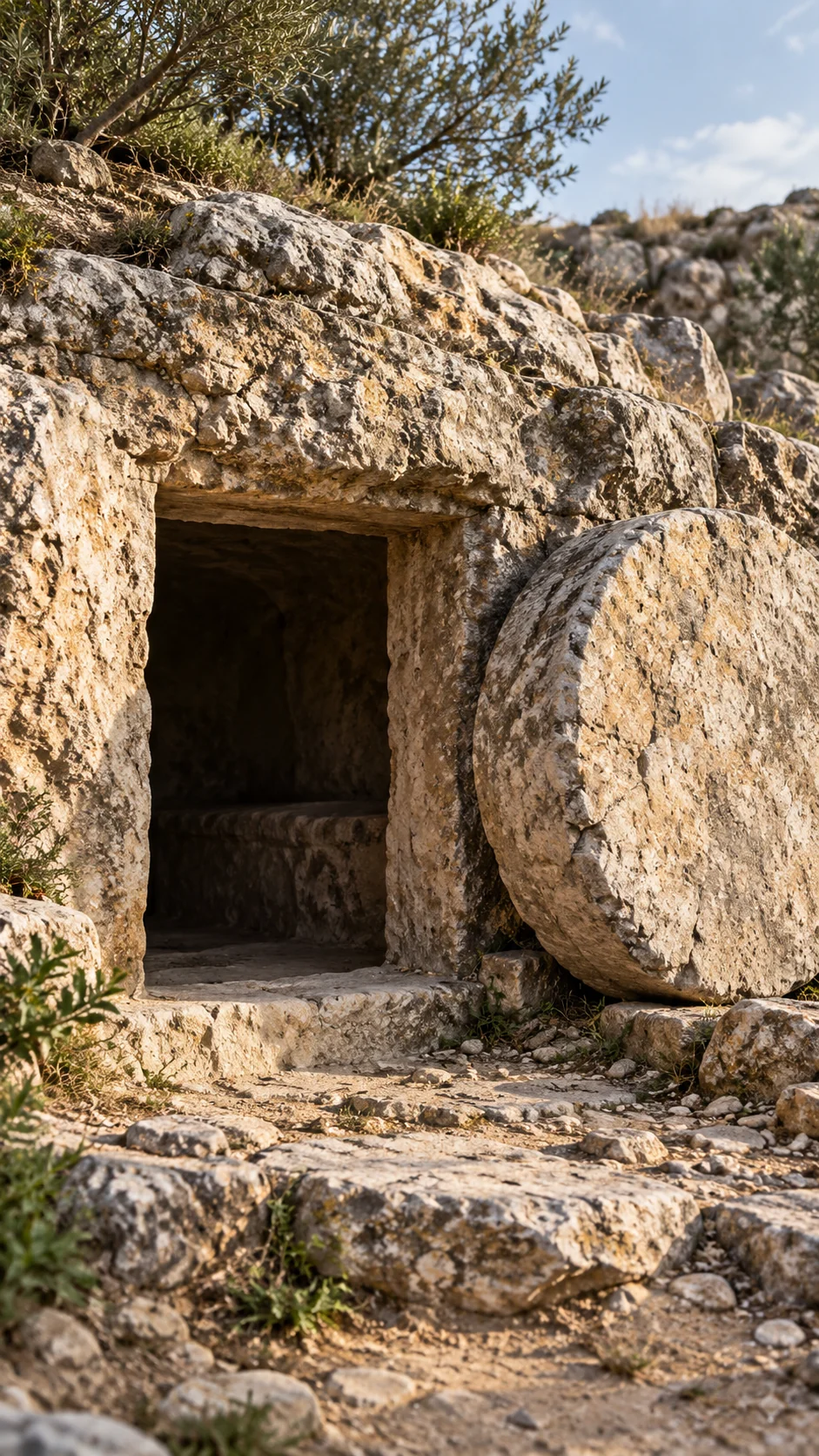
Christianity rests on historical claims. God did not merely inspire private insight, Christians say. God acted in Israel, became incarnate in Jesus, raised him from death, and founded a community that preserves the news. Paul states the wager with unusual clarity: “if Christ be not raised, your faith is vain.” [34] The resurrection is not a decorative belief. It is the central proposed miracle by which Christian theology enters public history.
A miracle can mean an unusual event, an event caused by God, or a violation of a law of nature. Those meanings should not be confused. Recovering from an illness against poor odds is unusual but does not by itself show that a law was broken. An event could have an unknown natural cause. Even if an event exceeded current natural explanation, identifying its cause as the Christian God would require further evidence.
David Hume's famous discussion asks whether testimony for a miracle is strong enough to overcome the evidence supporting the regularity of nature. His argument is often compressed into the claim that miracles are impossible by definition. That is too crude. Hume's deeper point is comparative: rational belief should follow the less extraordinary error. We must weigh the chance that testimony is mistaken against the chance that a well-supported regularity has failed. [30]
John Earman criticized Hume's reasoning and rhetoric, arguing that his case does not supply a sound general ban on believing miracles. [31] The criticism is useful. Historical testimony can in principle establish surprising events. A rigid rule that no amount of evidence could support a miracle would protect naturalism dogmatically. The atheist does not need that rule. The question is whether the actual evidence is sufficiently strong and specific.
Prior probability is unavoidable. If a friend says she ate oatmeal, modest testimony is enough. If she says she levitated over the city, we properly seek independent confirmation. This is not because levitation has been disproved in every possible world. It is because our background knowledge gives us many familiar explanations for extraordinary reports and no verified mechanism for unsupported human flight. The same principle operates in courts, journalism, medicine, and science.
Death is especially well understood. People can be wrongly declared dead, recover after cardiac arrest, or survive conditions once considered hopeless. Those cases involve incomplete biological death, not a return after bodily decomposition. The resurrection claim about Jesus is stronger: he was executed, buried, and later raised through divine power into transformed life. Such a claim needs evidence capable of distinguishing resurrection from error, legend, vision, theological development, and other human processes.
The earliest surviving Christian writings are Paul's letters. In 1 Corinthians 15, Paul reports a tradition that Christ died, was buried, was raised on the third day, and appeared to Cephas, the Twelve, more than five hundred people, James, all the apostles, and finally Paul. [34] Many scholars regard at least part of this formulation as an early tradition received by Paul. It shows that resurrection belief was not a legend first invented centuries later. Something close to the center of the claim existed in the movement's first decades. [32] [33]
That supports an early date for resurrection belief. It is not the same as five hundred preserved eyewitness interviews. Paul does not name most of the group, describe what they saw, state where the appearance occurred, or give us their individual testimony. We do not have their accounts to compare. “The Twelve” may function as a group title, and the sequence places Paul's experience in the same list even though Acts portrays it as a heavenly encounter after the ascension. [34]
Paul's letters contain little about an empty tomb. The four Gospels, written later than Paul's undisputed letters, provide burial and discovery narratives with overlapping cores and differing details. The women, angelic figures, messages, locations, and appearance sequences are not identical. Ancient writers were not composing modern transcripts, so variation does not make the stories worthless. It does prevent the casual claim that we possess several fully independent, matching eyewitness reports.
The Gospel authors are anonymous within the narrative texts, though early church tradition associates them with Matthew, Mark, Luke, and John. Luke explicitly says that he drew on earlier accounts and investigated traditions. [34] That is the voice of a compiler, not a declaration that every scene was personally witnessed. The Gospels can preserve early testimony while also reflecting decades of oral transmission, literary shaping, scripture interpretation, and community theology.
The burial by Joseph of Arimathaea and the discovery by women are often defended through criteria of embarrassment and multiple attestation. Women had limited legal standing in some ancient settings, so, the argument goes, inventors would not make them the first witnesses. The point has some force but is not decisive. Women were central to burial customs, and a narrative can include a socially disadvantaged witness for literary or theological reasons. The accounts also differ in ways that complicate claims of simple independence.
The empty tomb itself is historically debated. Dale Allison concludes that the resurrection traditions deserve serious historical treatment while remaining more ambiguous than either apologetic certainty or dismissive skepticism admits. [32] Michael Licona argues at length that the resurrection provides the best explanation of several historical facts. [33] The disagreement among specialists is a reminder that the inference, not merely the raw evidence, is contested.
Suppose we grant a strong minimal case: Jesus died by crucifixion; some followers soon believed he appeared to them alive; Paul converted after an experience he understood as an appearance; James became a leader in the movement; and resurrection proclamation arose early. Those facts still underdetermine the cause. Bereavement experiences occur. Individuals and groups can interpret ambiguous events within powerful expectations. Memory changes through retelling. Scriptural themes can structure experience. None of these mechanisms must explain every detail alone for them collectively to remain more familiar than bodily resurrection by God.
Apologists sometimes demand one complete naturalistic scenario that explains all details with equal elegance. Historical reasoning rarely works that way. We often know that a source is insufficient to establish a cause without reconstructing every step of what actually happened. If several witnesses report lights over a field, a researcher may rationally withhold belief in an alien spacecraft even without proving whether the cause was aircraft, astronomy, misperception, exaggeration, or several events combined.
Hallucination is frequently treated as the sole alternative and then rejected because groups do not share identical hallucinations. The category of religious experience is broader. One person can report a vision, others can have dreams or sensed presences, and a community can come to share an interpretation. Group expectation can shape memory and testimony without every participant perceiving the same private image at the same instant. The sources do not give enough clinical detail to diagnose a single mechanism.
Legendary development also need not mean that the whole claim began late. An early conviction can acquire concrete narrative detail as communities preach, worship, argue, and read scripture. The fact that resurrection belief was early weighs against a very late invention, but it does not establish that every later scene is primitive or literal.
Fraud is another possibility, though it is often presented as the only rival to truth. The disciples could be sincere and mistaken. Willingness to suffer shows commitment, not accuracy. People in many religions endure persecution for beliefs outsiders regard as false. For the first disciples, evidence about individual martyrdoms is also uneven. Peter, Paul, and James have stronger early traditions than many figures whose elaborate deaths appear in later sources.
The “wrong tomb” and “swoon” theories are likewise not required. A successful atheist case need not prove that Jesus survived or that everyone visited the wrong location. It can grant death and explain why the available texts do not bridge the distance from early resurrection faith to a verified supernatural event. Multiplying weak alternatives is less important than evaluating the evidential force of the sources we possess.
Could God make a resurrection probable despite the low natural prior? Yes. If independent reasons strongly established that a good God intended to vindicate Jesus, the event would become less surprising. But using Christian theology to raise the probability of the resurrection while using the resurrection to prove Christian theology risks circularity. The cosmological, moral, experiential, and scriptural cases must carry enough independent weight. Earlier sections have argued that they do not.
Miracle reports outside Christianity create a consistency test. Devotees report healings at shrines, apparitions, fulfilled prophecies, relics, reincarnation memories, supernatural protection, and encounters with founders or saints. Christians usually do not accept the full theological interpretation of rival reports. They appeal to error, fraud, coincidence, psychology, or perhaps deceptive spirits. Once those explanatory resources are admitted, they cannot be excluded merely when Christian testimony appears.
A miracle would also prove less than many assume. An unexplained healing would not establish the Trinity, biblical inerrancy, substitutionary atonement, or a particular church. Even a genuine return of Jesus from death would show that something extraordinary happened around Jesus. Connecting it to a complete theology would still require interpreting what power acted, why it acted, and which later doctrines accurately represent it.
This point does not empty the event of significance. If Jesus publicly returned in a way open to contemporary examination, sustained interaction, and independent testing, atheists would need to revise their beliefs. Evidence can defeat a prior. The historical problem is that we have ancient texts reporting experiences and traditions, not a presently examinable risen person. The surviving record supports the conclusion that early Christians sincerely proclaimed resurrection more strongly than it supports the conclusion that a creator suspended death.
Faith may accept the remaining distance. It may treat the character of Jesus, inner witness, scripture, and community as a cumulative context in which resurrection becomes credible. That is a religious commitment, not an unavoidable historical verdict. When ordinary explanations are imperfect but well established, and the supernatural explanation introduces a divine agent whose existence is the disputed point, withholding belief is reasonable.
The atheist position is neither “miracles cannot happen” nor “the disciples were liars.” It is that extraordinary historical claims require evidence proportionate to their specificity and improbability. The resurrection sources are important, early by ancient standards, and worthy of study. They do not provide enough independent control, detail, or convergence to make divine resurrection the best explanation for someone who does not already assume Christian theism.