
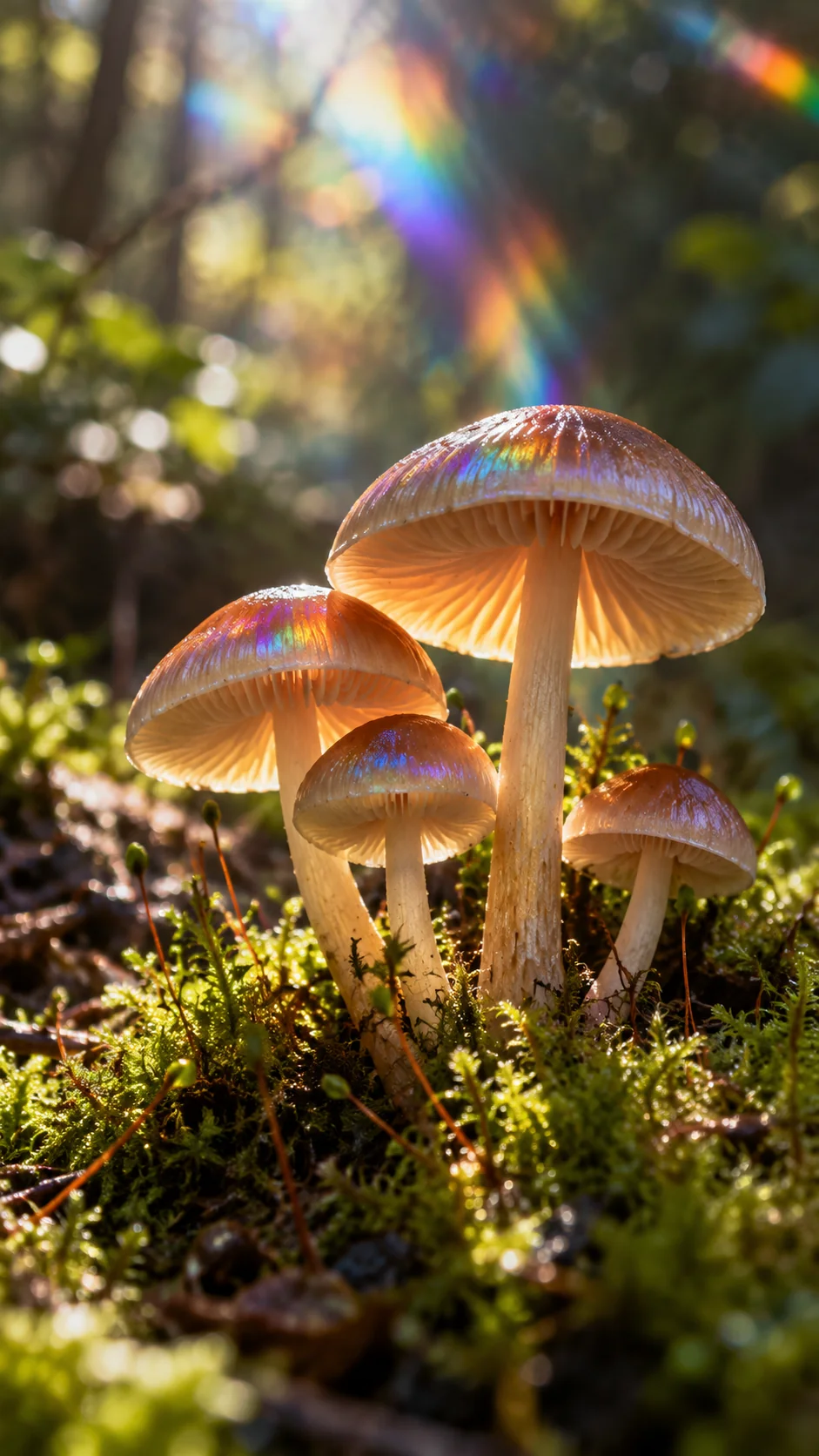
Mystical experience has long been treated as evidence that the mind can encounter something beyond ordinary physical reality. But modern psychedelic research creates an uncomfortable complication: experiences described as sacred, timeless, unified, ineffable, and more real than everyday life can sometimes be produced under controlled conditions by changing brain chemistry.
That does not make the experiences fake. It does make the argument from experience harder. A person can sincerely undergo something life-changing while the interpretation of what happened remains open.
Researchers can reliably measure “mystical-type” experiences
In a landmark 2006 Johns Hopkins study, Roland Griffiths and colleagues gave psilocybin to hallucinogen-naive adults who regularly participated in religious or spiritual activities. Under supportive laboratory conditions, participants reported experiences with features traditionally associated with mysticism, and many later rated the session among the most personally meaningful experiences of their lives. Griffiths et al., “Psilocybin Can Occasion Mystical-Type Experiences”
Researchers later validated a 30-item Mystical Experience Questionnaire, or MEQ30, using pooled data from controlled psilocybin studies. The scale measures dimensions such as unity, sacredness, positive mood, transcendence of time and space, and ineffability. It does not measure whether God was objectively present. It measures characteristics of the reported experience. Barrett, Johnson, and Griffiths, “Validation of the Revised Mystical Experience Questionnaire”
That distinction is easy to miss. A questionnaire can establish that someone had an experience strongly resembling reports historically called mystical. It cannot independently verify the metaphysical explanation attached to that experience.
The science and the spiritual language are becoming tangled
The tension has become more visible as psychedelic medicine moves toward the mainstream. In a 2026 article in *Culture, Medicine, and Psychiatry*, anthropologist Aidan Seale-Feldman describes what she calls “secular mysticism”: a space where clinical medicine, neuroscience, spiritual language, therapy, and religious practice increasingly overlap. Her research draws on public discourse, psychedelic science conferences, a therapy training program, and a psychedelic church. Aidan Seale-Feldman, “Secular Mysticism”
The problem is not simply that some researchers use spiritual words. Psychedelic experiences are unusually sensitive to “set and setting,” meaning a person’s expectations, mental state, social environment, and the context in which the drug is taken. Seale-Feldman notes that this creates a challenge for the normal medical model, because the subjective environment can be entangled with the drug’s effects.
So imagine two people have similarly intense experiences. One says, “I encountered God.” Another says, “My brain generated a powerful state of unity.” A third says, “The distinction between brain and God is the wrong question.” The phenomenology alone does not choose among them.
Does a drug-induced experience count against religion?
Not automatically. A Christian, Hindu, Buddhist, or other religious believer can argue that changing the brain does not prove an experience is false. Every ordinary perception also has neural correlates. Seeing a tree changes brain activity, but that does not mean the tree is imaginary. A believer could say psychedelics alter the brain in a way that makes a genuine spiritual reality easier to perceive.
That reply is logically possible, and a secular analysis should not pretend otherwise. The harder question is evidential: what feature of the experience lets us distinguish “the brain generated this” from “the brain detected something outside itself”?
The fact that an experience is profound cannot do that work by itself. Profundity is part of the phenomenon being explained. The same is true of certainty. People can feel absolutely convinced by incompatible religious interpretations, and psychedelic states can produce a strong sense of insight or revelation without providing an external test of the proposition that seemed revealed.
The experience can matter without proving its interpretation
There is a temptation on both sides to force a metaphysical conclusion. A religious reader may say that an overwhelming sense of unity proves contact with the divine. A skeptic may say that because a chemical can induce something similar, all mystical experience has been debunked. Neither conclusion follows that quickly.
The experiments show that human brains are capable of entering states that feel deeply sacred and noetic, meaning they seem to carry knowledge rather than merely emotion. They show that those states can be influenced by pharmacology and context. They also show that the experiences can remain meaningful long after the acute drug effects end.
What they do not show is that every mystical experience has the same cause, or that the metaphysical beliefs attached to one are true.
That leaves a surprisingly secular conclusion. Meaning and certainty are experiences too. They deserve to be taken seriously as parts of human life, but they are not self-authenticating evidence. If a mystical experience leads someone to a claim about reality, that claim still has to face the same question as any other: what evidence could distinguish it from the alternatives?